
Readings and Resources
Archival documents, articles, programs, and audio resources about Alexander Kipnis.
ALEXANDER KIPNIS - BORIS GODUNOV, RUSSIAN OPERATIC ARIAS
ALEXANDER KIPNIS - BORIS GODUNOV, RUSSIAN OPERATIC ARIAS, AND SONGS
Liner Notes by Igor Kipnis
Igor Kipnis wrote these liner notes for RCA Red Seal, to be used on Alexander Kipnis: Boris Godunov, Russian Operatic Areas, and Songer. These notes were never used by RCA. However, we have a rough draft of these notes in our files at the Alexander Kipnis Society, and we are delighted to share them with you.
Russian arias, art songs, or folk songs invariably were included in my father's recital programs no matter the country in which he performed, for that was to be expected of any Russian-born singer (Feb. 1, 1891, Zhitomir, Ukraine - May 14, 1978, Westport, Connecticut). Bold drama and vivid characterization, in addition to his remarkably bel canto qualities, were distinguishing hallmarks of his style on the operatic stage as well as on the concert platform. I can well recall what a frightening figure he made of the evil Hagen in Wagner's Götterdämmerung, no less so when one saw him in his Metropolitan Opera dressing room still in costume after the performance. Equally memorable are two Boris Godunov vignettes: the sheer, demented terror of his clock scene, as he threw any available stage furniture at the apparition of the ghostly child, and the final death agony, when his collapse down several steps of the raised throne caused even seasoned opera goers to gasp.
On the recital stage as well, he always succeeded in bringing to life the mood of whatever portrayed, whether the tyrannical, yet panic-stricken Boris, the tripartite personifications of Schubert's Erlkönig, the rhapsodic descriptions of the apocryphal Lieutenant Kije of Prokofiev, whose vocal excerpts he often sang, or the myriad macabrisms of Mussorgsky's Songs and Dances of Death.
The title role of Boris Godunov was one in which he really should have made his Metropolitan Opera debut during the 1939-40 season, but Edward Johnson, then the company's manager, dissuaded my father because of the shabbiness of the Met's old production (this was not a period in the history of the opera house when new mountings were prevalent). So it was as Gournemanz in Parsifal that he first appeared on the Met stage on Jan. 6, 1940, a role with which he was much associated, having sung the part in Bayreuth (with conductors Muck and Strauss), the Berlin State Opera, London's Covent Garden, Buenos Aires's Teatro Colon (with Busch), and the Chicago Civic Opera, among others. In his long operatic career on three continents, incidentally, he amassed a total of nearly eighty different bass or bass-baritone roles.
It was in Chicago during the 1924-25 season, in fact, that he took the role of Varlaam (in Italian, the language of the rest of the cast) to Feodor Chaliapin's Boris who sang his part in Russian. My father's first title-role Boris other than the usual excerpts in recital, was a concert performance in German in The Hague. In a stage production in Vichy, France, the local chorus sang in French, while he and the other principals sang in Russian but in evening dress, the train carrying the costumes, not having arrived in time. His firm, stated belief, however, was that the opera sounded entirely different as well as far superior in the original language with its sharp consonants and sustained, open tones.
Likewise, for reasons of vocal writing and modulations more natural and dramatic, he felt, to the voice, he very much preferred the Rimsky-Korsakov orchestration, which after all was the standard version of his day. His opinion, incidentally, did not change when in 1944 he gave the world premiere performance with Fritz Reiner and the New York Philharmonic of three scenes from Boris in the Shostakovich orchestration. In general, it was Boris that he felt to be his best part, both vocally and dramatically.
His highly praised Metropolitan Boris with George Szell conducting, first took place on February 13, 1943. He sang in Russian, the rest of the cast, including the Russian-born Irra Petina as Feodor, Boris's son, in Italian (from 1912 and the time of Toscanini on until the English language version of 1953, Italian had always been used by the entire cast, the sole exceptions being my father and Chaliapin, the original orchestration production all in Russian not taking place until 1974). Recording of excerpts was planned. However, the so-called Petrillo ban of 1942, which had been instigated by the powerful, Chicago-based head of the musician's union, caused a halt to all United States recording activity until the beginning of 1945.
On tour, my father received a hasty message from RCA Victor to cancel all his other immediate engagements so that the long-postponed recording session of Boris highlights, all in Russian, could finally take place. There was also some personal and corporate rivalry involved, for once the ban was lifted, Columbia Records began to work just as diligently to record a similar set, in Italian with Ezio Pinza, who had split the title role in 1943 with my father. Robert Shaw, who conducted the Victor Chorale (later to become the Robert Shaw Chorale) recounted to me only a few years ago his impressions of this, his very first session for RCA Victor, which was held on the top floor of New York's Lotus Club on 57th Street. He remembered in particular how very dramatic in the death scene were my father's final utterances. Victor DM-1000 appeared about a month before the competition, and its success occasioned a follow-up recording of Russian operatic arias a year later, these being the last of his discs among a total of 139 76 rpm sides recorded between 1916 and 1946.
IGOR KIPNIS, Redding, Connecticut
Kipnis's Lecture to the Friends of Music, Westport, CT 1971
Note: We are happy to share with you the following document - a transcript of a lecture given by Alexander Kipnis in 1971.
Transcript of Alexander Kipnis's Lecture to the Friends of Music, Westport, Connecticut, February 12, 1971
On February 12, 1971, Alexander Kipnis gave a lecture to an organization called The Friends of Music in Westport, Connecticut. The setting is significant, because Kipnis and his wife Mildred were living nearby in Westport at the time. Please note that the text of this lecture is available in the Oral History of American Music archives at Yale University. However, here at the Alexander Kipnis Society, we are privileged to own an audio recording of the lecture, which is both authoritative and flavorful, thanks to Kipnis's own warmth as a raconteur and laughter and other reactions from the crowd. A recording of this lecture is available from us on our organization's Google Drive, and we will be pleased to share it with you. Please contact the Society via email at barrylenson@gmail.com. With that said, please enjoy this transcript of what the great Alexander Kipnis said on that day. Think of this as a small holiday present from us at the Alexander Kipnis Society. All good wishes for a wonderful year 2026.
Moderator: Mr. [inaudible] could not be here. He has asked me to introduce Mr. Kipnis, our speaker this evening. It's a great privilege for me as a member of the committee, which organizes this series of pre-concert lectures. And as a great artist and great singer, Mr. Kipnis is definitely qualified to speak on this subject. We are very grateful to Mr. and Mrs. Sabo for being our hosts this evening. I'm sure now you will enjoy this rare privilege of hearing Mr. Kipnis. [APPLAUSE]
Alexander Kipnis: Good evening to you. There are many musicians among you, I might speak something which would be not very pleasant to hear, about what I have to say about musicians. Because you know musicians are ordinary people and normal people the way we all are. Musicians we have them of different kind of different natures. Some are very simple and some are very conceited. Some of them think that the whole world is turning around each one of them. They have such an ego that they believe they are the center of the world. Actually, some of them have to have that ego, otherwise they cannot perform.
I have seen great artists, pianists, violinists and especially singers who have been so conceited that even if they had to sing this smallest part, they believed the success of the performance depends on this small part. I had an opportunity last week to listen to a very very famous singer. It was in the Juilliard Theatre and it was an evening they called Questions and Answers from Maria Callas. She spoke, she answered questions and it lasted approximately an hour and a half. She said, for instance, that Mozart is by far overestimated. He is not an important musician, he is not an important composer. Puccini, she hates because he destroys the voices. The greatest operas she mentioned are La Traviata and Norma, because in Traviata and in Norma there are some coloratura arias. If an opera doesn't have coloratura, then it's not good.
It was very amusing to see how a person is evaluating music, because she does not have a part in it. For instance, she didn't mention Otello, she didn't mention Aida, she didn't mention Pelléas and Melisande, she didn't mention any other opera which doesn't have any coloratura. The coloratura part, for an unknown reason, in this country if somebody can sing runs very quickly, she is considered a bel canto singer. And if he cannot do that, then he doesn't classify. Caruso, for instance, didn't sing runs. Bonci, or shall we say, Tebaldi, who could not sing coloratura runs, they are not bel canto singers. Bel canto is a privilege only for boys, for girls who can sing cadenzas and trills and so forth.
I have known great singers who have been very modest and very timid. They simply couldn't speak in the presence of two or three other persons. But as soon as they had to perform, the same timid and silent person became the character of this opera which he had to perform. And I have seen, on the other hand, great artists who could only speak about themselves, like Caruso, Mary Garden, Chaliapin. I sang with all of them. It was impossible to have any conversation with them about anything else except their own singing. And their ego was so penetrating that they would rather bite their tongue before they would pay any little compliment to another character. And sometimes they themselves were not so great. Mary Garden was a great artist, a great actress, but her voice was not very good. Chaliapin, with whom I sang many, many performances, was possibly the greatest actor on the operatic stage, but his voice was by far, by far, not very appealing. His range was not very good, the quality was very bad, and so on and so forth.
I could go on and on and tell you about the different characters, but again, as I said before, in order to be able to perform and to convince an audience that they are really great and strong and they are performing the character, they have to be like that. Some of them, they simply cannot, if you take away the ego from such a person, they cannot perform and they cannot sing. There again, some of the musicians of the singers have to perform and sing parts which appeal to them personally and also make them capable to sing these parts. Some person is a very quiet pacifying for personality, and suddenly he has to sing the Mephistophèles on the stage. How can he do that if he doesn't have this ego? Some gentleman is very smooth, very gentleman-like, has to sing an awful character like the Baron Ochs in der Rosenkavalier. And if he cannot transfer his personality into this ugly character of the Baron Ochs, then he is just not good.
Then we have performance, stage performance, and concert performance. At that evening last week, Callas was asked, "What do you think about singing Lieder?" Oh, she said, Lieder is impossible. I cannot live my life. I would explode if I had to sing a song. There is no dramatic development in a Lied. If you give me Tosca, or you give me... She admitted she likes Wagner. She sang Wagner and Fidelio. It is something, you know, if you take, shall we say, a flute, and you ask the flutist to play some sonata for trombone. Such a thin little voice as she had to sing Isolde. She did it, she said. It was a Fidelio.
And I want to get away from this characterization of singers. We have tomorrow evening a recital with a beautiful program, it starts with three arias, or two arias, I don't know, by Bach. And I would like to play you an aria from a Bach cantata. And to show you how Bach should sound, you will have an opportunity to compare. [PLAYS RECORDING] The orchestra is the Viennese Philharmonic and the singer is Hilde Rössel-Majdan, a very, very fine mezzo soprano or contralto.
And on the program tomorrow, Bach is followed by Mendelssohn. And later on by Mahler. I don't know how familiar you are with Mendelssohn's songs. He has written many beautiful songs. They became beautiful folk songs. So beautiful they are. The one, for instance, is "On Wings of Songs," or "Auf Flügeln des Gesanges." Another one is the first violet, there is a beautiful song about the moon, and then we have a number of other songs, which we are going to hear now.
They're getting through with Bach. They have to wait quite a while, you know, after Mendelssohn, after Bach. There was quite a long while until Mendelssohn came. And as a matter of fact, Mendelssohn revived Bach. Bach was forgotten completely at that time. And if Mendelssohn didn't do anything else, than to rediscover Bach, then Mendelssohn would have been still a very, very famous and important person in the world of music. He died very young, as you know. He composed a great deal of music. I think he was not even 15 years old when he composed the music to A Midsummer Night's Dream. Some of the songs which he has composed have been, before he was even 20 years old, he had used some of the poems of Heine. For instance, this "Auf Flügeln des Gesanges" is a Heine poem.
And now I would like you to hear some of the Mahler songs. I never met Mahler, but in a way I inherited Mahler. I sang a great deal in this country, as well as in England and in Germany, with Bruno Walter. Bruno Walter was almost a puppet of Mahler. He tried in every way to imitate, to do the same thing that Mahler did. He dressed himself like Mahler. He spoke like Mahler. He did all sorts of things which are sometimes not very pleasant, because Mahler did it. Bruno Walter thought that Mahler was a genius. He said, "When I met Mahler for the first time, I realized what a genius is. He couldn't do wrongly. Every call he played, every expression he spoke, was the expression of a genius."
There was a time when people didn't think very much of Mahler's creations, but little by little his symphonies are getting more popular. These songs are composed more or less of the Czechoslovakian German folklore. Mostly the sound of the songs comes from marching soldiers. Sad songs, a sort of humorous songs. A song, for instance, "Wer hat dies Liedlein erdacht?" ("Who has invented this song?") Or, "Ich ging mit Lust durch einem grünen Wald" ("I walked with joy through a green forest.") Or, "Ich bin der Welt abhanden gekommen" ("I have been lost to this world.") Or, "Wo die schönen Trompeten blasen" ("Where the beautiful trumpets sound"). They are beautifully orchestrated and beautiful set to the voice.
Next one is, "If you love for beauty," "Liebst du um Schönheit." This girl says, if you love for beauty, I am the wrong one. If you love for wealth, I am the wrong one, there's so much more wealth in the world. But if you love for love's sake, then love me. So, from female voices, we will switch over to a man, a tenor who sings the song, "Invitation au Voyage" by Henri Duparc. The tenor is Leopold Simoneau.
In Europe, there is the opinion that the singer singing a concert should be completely without motion, should stay quiet, lean against the piano, and sing with open mouth and sometimes with closed eyes. No gestures, no expression, in his face. If somebody is trying to act a little bit on the stage, then he is not considered a concert singer, he is not good. But a number of artists came to this country, to Latin America, and they realized they are singing to an audience who don't understand them. It is not enough to have a translation in the program. The people don't read it. It's too dark very often. The people cannot read, and even if they have the light, they don't have the time to read. And little by little, they started to act with their faces, with their hands, trying to submit to the audience the meaning of a poem.
A very strange example was Chaliapin. He was principally an actor, and he did not know many good songs. He knew some Tchaikovsky songs, one or two songs by Rachmaninoff or by Mussourgsky, a few arias, and this is the way he performed. And I remember he sang once a song called "The Old Song," ("Der Alte Lied") by Grieg, and the poem is, there was an old king, his hair was grey, his mind was old. This old king took a young woman from America. There was a young page, his mind was very light, and his hair was blonde. This page carried the tray of the queen. Do you know the old song, because this is still the song, do you know the old song, they die, the queen and the page, because they were so much in love. So when Chaliapin sang this song, he acted. There was the young page carrying the train of the queen, and that's a certain point. [LAUGHTER]
Well, anyway, this is the difference about approach, one way or another. It is difficult from the step down from the concert stage to the opera stage and to be a good actor. It's also difficult to come from the operatic stage and be a very good concert singer. So it is very difficult to switch from one element to the other element. Some of the best operatic singers cannot sing recitals. The program consists of five, six, eight, ten arias. One aria is the same thing as the other. In one aria is same thing as the other aria, loud, sustained tones, or some whisper tones, but something without meaning at all.
I would like to play for you now a self-operatic idea. My recording. [PLAYS RECORDING OF "DER SOLDAT" BY HUGO WOLF] I'm not trying to sell it to you, because yesterday it was sold out in New York. The first song, they are very short, all of them, "Der Soldat." And the poet [Eichendorff] says, my horse is not very, very beautiful, but he is a very wise, a wise horse. He brought me to a little castle. There is a maiden living there. She is certainly not the most beautiful girl in the world, but I like her very much. And when she starts to speak about marriage, I swing myself on my horse and I stay outside when she is in the castle.
[PLAYS RECORDING OF "DER MUSIKANT" BY HUGO WOLF] The musician. "I love to wander. I live where I can. I know some very, very sad songs to sleep and to walk outside without shoes in the snow. Some girl is making eyes to me. She believes I like her. But this is not my style. If we would be married, then I would forget my singing. I don't know how to do it."
[PLAYS RECORDING OF "GRENZEN DER MENSCHHEIT" BY FRANZ SCHUBERT TO A POEM BY GOETHE] This is a very serious song. The words are by Goethe, and the title is "Limitation of Humanity." He compares what is the difference between Gods and Men. God is an eternal stream. You cannot compare. A human being is a very limited little circle. And before you realize, the circle has ended and you're gone.
If you follow by another, I would say a rather humorous song by Hugo Wolf, "Koptisches Lied" [Coptic Song]. Never try to make out of a fool a wise man. All the wise people in the world have realized that you cannot make out of a fool a wise man. In the highest mountains and in the lowest graves, I have heard the whispering, let the fool be a fool. And don't try to make a wise man a fool.
It's getting late and I would like to play you an aria which I recorded in 1925. Do you remember where you were in 1925? It was the first electric recording at that time I made Berlin in a very beautiful concert hall and the people were afraid to see the microphone. The microphone was somewhere. It was him like an atomic bomb. And I had on the stage a big and enormous big orchestra and I recorded at that time I'm sure you are all familiar with Wotan's Farewell. Wotan has put to sleep his most favorite daughter and he's saying farewell to her in this recording. [PLAYS RECORDING OF WOTAN'S FAREWELL FROM GÖTTERDÄMMERUNG BY WAGNER]
[THE AUDIENCE SINGS HAPPY BIRTHDAY TO ALEXANDER KIPNIS] Happy birthday to you! Happy birthday to you! Oh, happy birthday dear Sasha! Happy birthday to you!
"Alexander Kipnis" — 1935 article written by Walter Legge
Download PDFNew Discovery: 1926 Letter from Siegfried Wagner to Kipnis — Translation by Falk Struckmann and Emily Rawlins
Download PDFFax that Astrid Varnay sent to Igor Kipnis on May 30, 1992
Download PDF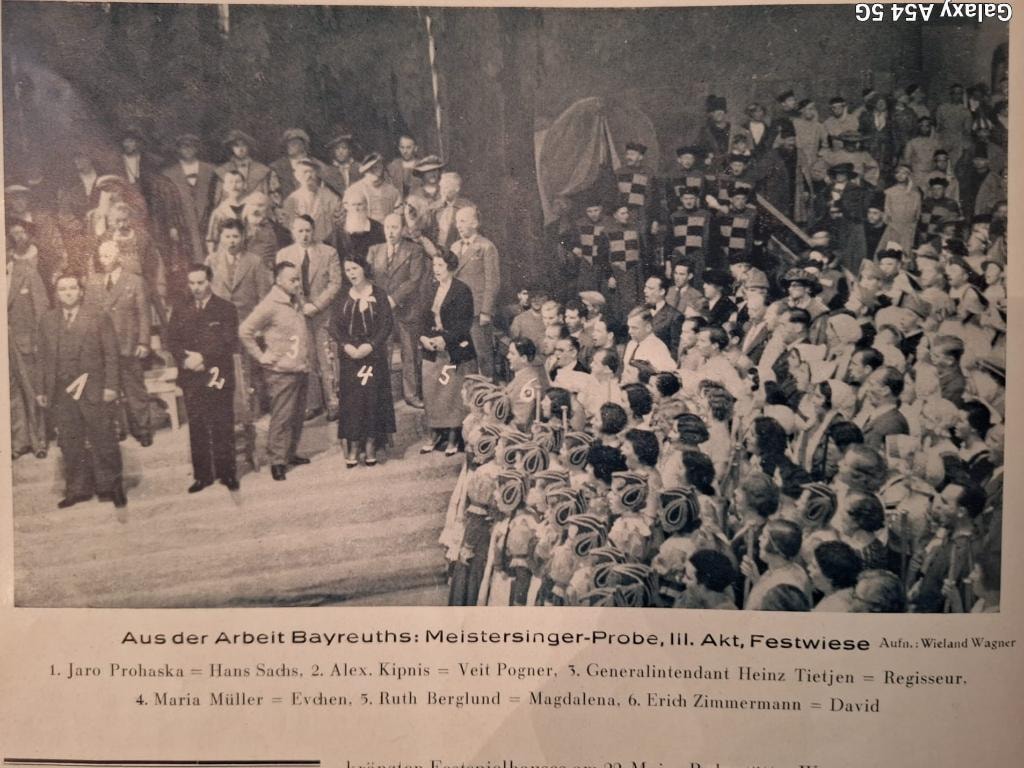
Igor Kipnis's Liner Notes for the RCA LP "Alexander Kipnis"
In 1961, Igor Kipnis wrote liner notes for an upcoming LP that RCA was about to issue of his father singing Russian songs and arias. Igor's liner notes were never used even though the album was released. (It has since been released in modified form by Preiser Records.) We recently discovered a copy of the original version of these notes as written by Igor and we are making them available to you as a download.
Liner Notes by Igor Kipnis for RCA Russian Arias and Songs Album (pdf)Program from a 1938 Kipnis Recital in New Zealand
We are pleased to share this scan of a program for a recital that Alexander Kipnis performed in four cities in New Zealand in 1938. He and pianist Noel Newson presented this ambitious program in Wellington, Dunedin, Christchurch and Auckland.
KIPNIS NEW ZEALAND RECITAL PROGRAM 1938 (pdf)From Our Advisor, The Great Countertenor Jochen Kowalski: His Personal Collection of Programs of Kipnis Opera Performances
A remarkable collection of Kipnis programs from his Berlin years 1926–1930. From the files of Igor Kipnis, Alexander's son.
Special Resources: Kipnis's Years in Wiesbaden
In this section you will find documents we have in our files that pertain to Kipnis's earliest performances with a "real" German opera company — the Wiesbaden opera, which he joined in 1915.
LATEST POSTING IN OUR RESOURCES SECTION
We have just posted Chapter Two, a chapter written in 2002 by Barry Lenson about Alexander Kipnis's early years in Warsaw. This was to have been the second chapter of a biography that was never completed or published.
Resources for Reading
- KIPNIS DISCUSSES ROLES HE SANG TOSCANINI AND MORE (docx)
- List of Roles Performed by Alexander Kipnis, Compiled by His Son Igor (doc)
- IGOR KIPNIS ESSAY ON HIS FATHER.doc (docx)
- The Art of Piano Singing by Alexander Kipnis (docx)
- Unpublished 2003 Article for Opera News by Barry Lenson (docx)
- Transcript of Interview with Judy Kipnis by Barry Lenson 1999 (rtf)
- Kipnis recalls Bayreuth his discovery of Flagstad and more (docx)
- Alexander Kipnis on Repertoire His Life and More (docx)
- Early Years in Zhitomir Chapter One Of Kipnis Biography by Barry Lenson 2003 (docx)
- Kipnis on Singing Teachers Vocal Technique and More (docx)
- KIPNIS ORAL HISTORY MEMOIR FOR AMERICAN JEWISH COMMITTEE (pdf)
- CHAPTER TWO OF KIPNIS BIOGRAPHY: WARSAW YEARS by Barry Lenson (docx)
- WAGNERIAN OPERA FESTIVAL PROGRAM (pdf)